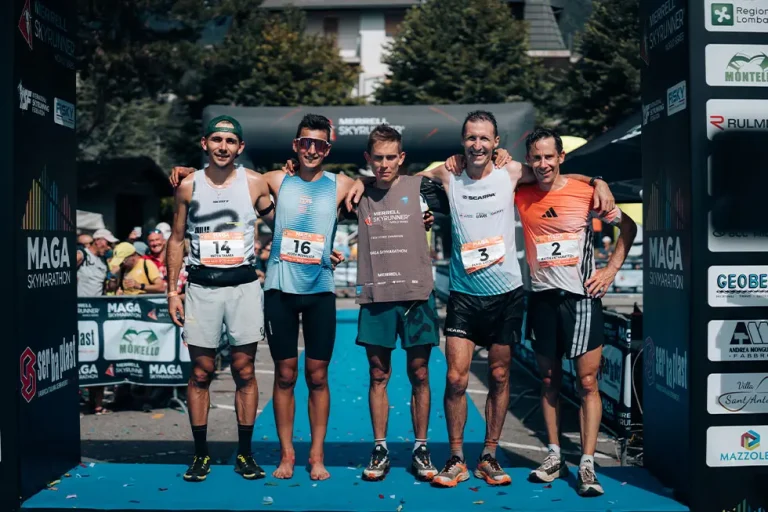
The Merrell Skyrunner® World Series Finals are the highest expression of mountain endurance, skill and human performance with steep climbs, fast descents, and unpredictable conditions that test every system in your body. Winning here isn’t about who trained the most miles. It’s about who arrives most prepared, physically, mentally, and neurologically balanced.
Train Your Brain and Body Together
Skyrunning demands control, reaction, and adaptability. Neuro-functional strength teaches your body to respond to the chaos of the mountains, slippery rock, side slopes, wind, and fatigue, with precision.
How to train it:
- Vision drills: Improve eye stability and terrain scanning. Use head-turns with fixed gaze or follow a moving target for 30 seconds at a time.
- Breath with intention: Learn to exhale during effort. It builds trunk stability and allows you to focus at altitude.
- Move in all directions: Step, twist, and lunge in diagonal and rotational patterns to mimic mountain movement.
- Train “odd positions”: Use ViPR Pro, Reax Flui or Chain, or sandbags to create off-balance loading that builds total-body stability.
These sessions don’t just make you stronger, they build the neural control that separates an athlete who reacts from one who anticipates.
Build Strong Joints and Elastic Fascia
Your joints are your armor, and your fascia, the connective web that holds everything together, is your energy system. When fascia is supple and strong, you move faster and absorb impact better.
How to train it:
- Focus on single-leg work (step-downs, reverse lunges, balance holds).
- Add reactive hops and gentle bouncing drills to train fascial elasticity.
- Combine strength and control, lift through full range, not just stability.
Master Downhill Control
Downhill running is where races are won, and legs are lost. It’s all about managing eccentric force, using elasticity, and reading terrain in real time.
Key Focus Areas:
- Eccentric strength: Step-downs, slow squats, and Nordic hamstring curls.
- Elasticity: Bounding, depth drops, and ankle hops for reactive control.
- Vision and balance: Train gaze shifts while moving; use unstable surfaces.
- Fatigue control: Practice technical descents after hard climbs to mimic late-race fatigue.
Train the Mind Like a Muscle
Mental endurance is what keeps your rhythm when the terrain gets steep or scary. Learning to control your breathing, vision, and inner dialogue changes how you handle fear, fatigue, and pressure.
Key Tools:
- Breathwork: Box breathing (4-in, 4-hold, 4-out, 4-hold) to calm nerves before a start line.
- Vision priming: Eye–head drills and visual focus resets before each training session.
- Mantras and self-talk: Short cues like “Strong and smooth” or “Flow and go.”
- If–Then plans: “If fear spikes on the ridge, then I take 3 slow breaths and focus on my next step.”
Travel Like a Pro
Flying across time zones or sitting for hours tightens muscles and scrambles your internal clock. A few small travel habits can make a huge difference by the time you toe the line.
Pre-Trip (3–5 days out):
- Shift your sleep and mealtimes toward your destination.
- Taper intensity slightly and focus on hydration.
In-Flight:
- Drink 8–10 oz water per hour.
- Stand and stretch every hour.
- Avoid alcohol and heavy meals.
Arrival:
- Get outside into sunlight immediately.
- Eat a local-time breakfast rich in protein and antioxidants.
- Move lightly (easy run, mobility, or yoga flow).
Altitude and Environment
Altitude is predictable stress. Oxygen drops, hydration demands rise, and weather can change in minutes. You can’t control the mountains, but you can prepare for them.
Adaptation Checklist:
- Arrive early: 3–5 days (U23) or 2–3 (Seniors) before race day.
- Hydrate constantly: Dry Mountain air means more fluid loss even in cool temps.
- Layer smart: Merino base-mid fleece-waterproof shell = adaptable comfort.
- Fuel often: Every 45–60 minutes, especially with carbs and electrolytes.
- Storm strategy: If thunder approaches, drop below the ridge, crouch low, and wait it out.
Fuel the Engine
At altitude, appetite drops but energy demands rise. The key is consistent fueling, small, steady inputs of carbs, fluids, and electrolytes.
Simple Framework:
- Pre-race: Carb-load moderately (6–8 g/kg/day) 36 hours out.
- During race: 200–300 kcal/hr from gels, chews, or soft foods.
- Post-race: 3:1 carb-to-protein ratio within 30 minutes of finishing.
Recover Like a Champion
Recovery isn’t rest, it’s adaptation. The best skyrunners plan their recovery as seriously as their training.
Travel Week Recovery Stack:
- Light mobility and hydration during flights.
- 20–30 min active movement on arrival.
- Compression, magnesium, and early bedtime.
Post-Race Recovery:
- Refuel immediately: Shake or meal with carbs + protein + electrolytes.
- Move the next day: Easy effort or yoga flow to keep blood flow.
- Sleep deep: 9–10 hrs for 3–5 days.
- Reduce inflammation: Tart cherry, turmeric, and omega-3s.
Race Day Strategy
- U23 Athletes: Focus on calm pacing, early hydration, and controlled breathing. Trust your fitness
- Seniors: Execute precision, fuel early, read terrain, and trust your fitness.
- All Athletes: Use your pre-race mental and visual warm-up. You’ve trained your systems; now trust them.
The Finish Line Mindset
At the finals, every athlete is fit, but not everyone is composed. The mountain rewards those who can stay calm in chaos.
You’ve built the systems: brain-body control, resilient joints, oxygen efficiency, emotional composure, and recovery discipline. Now, it’s about execution.
The goal isn’t to battle the mountain, t’s to move with it…..in Satori!
Research References
Fullagar HHK et al., Sports Medicine, 2015
Forbes-Robertson S et al., Scand J Med Sci Sports, 2012
Zwierko T et al., Human Movement Science, 2010
Behm DG et al., Strength & Conditioning J, 2018
Vernillo G et al., Sports Medicine, 2017
Van Cutsem J et al., Sports Medicine, 2017
Wilke J et al., Sports Medicine, 2017
Sawka MN et al., J Appl Physiol, 2007
Ivy JL & Portman J., Sports Nutrition, 2004