Breath, focus, footwork, and whole-body strength for technical terrain
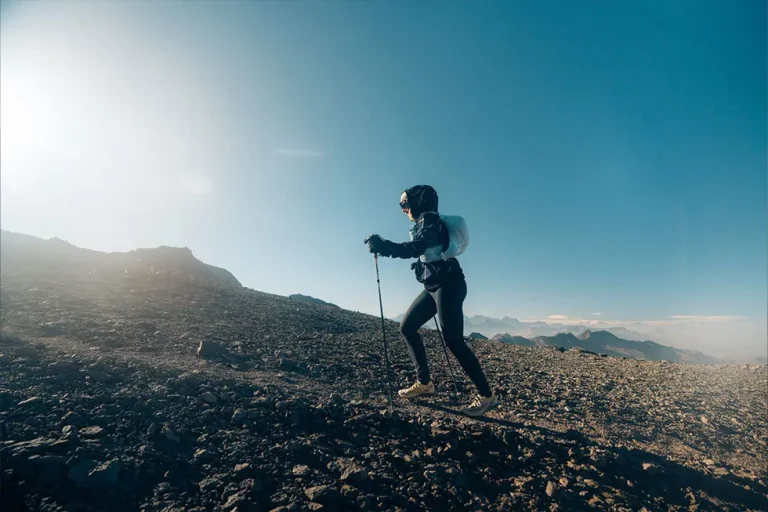
Skyrunning is defined by technical mountain terrain, steep climbs, rocky ridges, and descents where every step matters. Unlike road running, where rhythm and speed dominate, mountain running demands control, adaptability, and confidence when the trail disappears into boulder fields, scree, or exposed slabs. The best athletes aren’t just strong runners, they are skilled movers who can scramble efficiently, descend safely, and stay mentally calm in challenging environments.
This guide combines practical coaching with modern research to give skyrunners a toolkit for improving their rock and scramble abilities.
Breathe First, Move Second
In technical terrain, your mind often races before your feet do. Fear of slipping or overexertion on a steep climb can spike your heart rate and narrow your focus. That’s where breathing becomes a tool, not just a reflex. Studies have shown that slowing breathing to around six breaths per minute improves how the nervous system regulates stress and enhances mental clarity (Larson et al., 2020; Migliaccio et al., 2023).
For skyrunners, this means that your breath can be used as a reset button. Before committing to a sketchy scramble, implementing three to five rounds of controlled breathing can shift your body out of “fight or flight” and into a steadier state. During sustained climbs, syncing breath with steps creates rhythm and efficiency, especially when terrain forces you to move slower than you’d like.
Try this:
- Box Breathing (for exposed sections): Inhale for 4 seconds, hold for 2, exhale for 6–8. This lengthened exhale helps release tension and calm nerves.
- Step-Matched Breathing (for climbs): Inhale over 3 steps, exhale over 4–5. On steeper terrain, shorten to 2/3 to avoid breath-holding.
Mental Preparedness: Look Ahead, Not Down
In the mountains, your eyes are your guide. Research shows runners need at least two steps of visual information to place their feet accurately on uneven ground (Matthis & Fajen, 2014). Looking only at your toes slows reaction time and increases the risk of missteps.
Mental preparedness isn’t just about confidence, it’s about active planning. By consistently scanning two steps ahead, you give your brain time to process surface details, plan the movement, and prepare your muscles. Breaking technical sections into smaller “chunks” also helps; thinking in sequences of three to five movements (“right edge–left smear–high palm”) keeps you focused on manageable tasks rather than overwhelming exposure.
Practical tools:
- Two-Step Preview Rule: Always look at least two steps ahead.
- Chunking: Break scrambles into short, nameable movement patterns.
- Intensity Check: On a scale of 1–5, aim for 3–4 before committing. Too calm (1–2) and you’re sluggish; too hyped (5) and mistakes come quickly.
Eye–Foot Coordination: Training the Link
Good scrambling is about more than strong legs, it’s about how your brain, eyes, and feet work together. If your eyes can’t process terrain quickly, your foot placement will always lag. Training this coordination builds speed, accuracy, and confidence.
- Tape Targets: Place small markers on the ground and practice running while keeping your eyes two markers ahead. This mimics the forward-looking strategy needed on rocky ridges.
- Rock Hops: Use stones or gym tiles to hop in rhythm with a metronome (~170 bpm). Keep your eyes scanning forward while your feet land with precision. This builds stability and balance under pressure.
- Step-Down Precision: Drop off 30–60 cm ledges, landing softly on a specific spot. Studies on Parkour athletes show “precision landings” lower impact forces and reduce injury risk (Standing et al., 2015).
These drills train you to move through technical terrain with eyes guiding the action, not reacting too late.
Whole-Body Strength: The Integrated System
When scrambling, your body doesn’t use muscles in isolation, it moves in diagonals. Pushing with your left foot while reaching with your right hand involves a chain called the posterior oblique sling: glute, lower back fascia, and opposite-side latissimus (Lee et al., 2019; Almansoof et al., 2023). Training these slings builds stability, speed and efficiency so you can move smoothly across rock without wasted effort.
Cornerstone exercises:
- Cross-Body Step-Up and Reach: Step onto a box with one foot while reaching overhead with the opposite arm. This trains diagonal power transfer.
- Diagonal Band Chop: Pull a band across your body while loading the opposite foot, simulating edging or twisting over a rock face.
- Contralateral Carry: Hold a weight in one hand and walk over uneven ground, training balance and cross-body stabilization.
- Tall-Kneel Lat Pull-Back: With a high band anchor, engage glutes and pull back as if setting a mantle move on rock.
The goal is not just strength, but timing: learning how to connect foot, hip, and opposite shoulder so your whole body works as one.
Ascending Technical Rock
Climbing up rocks during a race is less about speed and more about efficiency. Overreaching wastes energy and breaks balance. Research shows runners naturally shift toward shorter, stiffer steps on uneven ground, which helps conserve energy and maintain stability (Voloshina & Ferris, 2015).
Key techniques for going up:
- Short, Controlled Strides: Avoid lunging. Smaller steps reduce slips and keep your center of gravity stable.
- Tripod Rule: Always have three points of contact, two feet and one hand, or two hands and one foot.
- Hips Over Feet: Shift your hips directly over your foothold before pulling with your hands. This ensures power comes from your legs, not your arms.
- Plan Two Holds Ahead: Never commit without knowing where your next two moves are.
Descending Technical Rock
Most skyrunning accidents happen on the downhill. Gravity makes descents faster, but speed without control is dangerous. A strong descent blends soft landings, smart lines, and constant scanning.
Key techniques for going down:
- Stay Low: Bend knees and hips to lower your center of mass, which improves stability and braking power.
- Quiet Landings: Aim to land softly, rolling pressure through your foot. Research from Parkour shows trained landings cut impact forces significantly (Puddle & Maulder, 2013).
- Zig-Zag Lines: Angling your descent shortens drops and spreads impact forces, rather than “bombing straight down.”
- Eyes Forward: Stick to the two-step preview rule even when fatigue tempts you to stare at your feet.
- Hands for Balance: Don’t hesitate to use hands for stability, treat down-scrambles as four-limbed movement when needed.
Quick Field Checklist
- Breathe slow before committing moves
- Always scan two steps ahead
- Use shorter, quieter strides on steep terrain
- Stay low and land softly on descents
- Train slings weekly: foot-glute-opposite lat
- Hands stabilize, feet drive
References
- Larson et al., Front Physiol (2020): Slow breathing improves nervous system regulation.
- Migliaccio et al., Sports (2023): Controlled breathing aids focus and concentration.
- Matthis & Fajen, J Exp Psychol (2014): Two-step preview improves foot placement accuracy.
- Voloshina & Ferris, J Exp Biol (2015): Uneven terrain raises energy cost, step variability, and leg stiffness.
- Standing et al., Sports Med Open (2015); Puddle & Maulder, J Sports Sci Med (2013): Parkour landing strategies reduce impact.
- Lee et al. (2019): Posterior oblique sling supports pelvic/trunk stability.
- Almansoof et al., Appl Sci (2023): Thoracolumbar fascia supports whole-body load transfer.